
 Get in touch




Climate Alliance principles
Our compass for municipal climate action

Successful climate action requires a comprehensive and sustainable approach.
Which climate solutions should we pursue, which should we abandon and how can we build more sustainable regions, cities and towns? Our Climate Alliance principles offer guidance!
A guide to fair climate action
Our principles
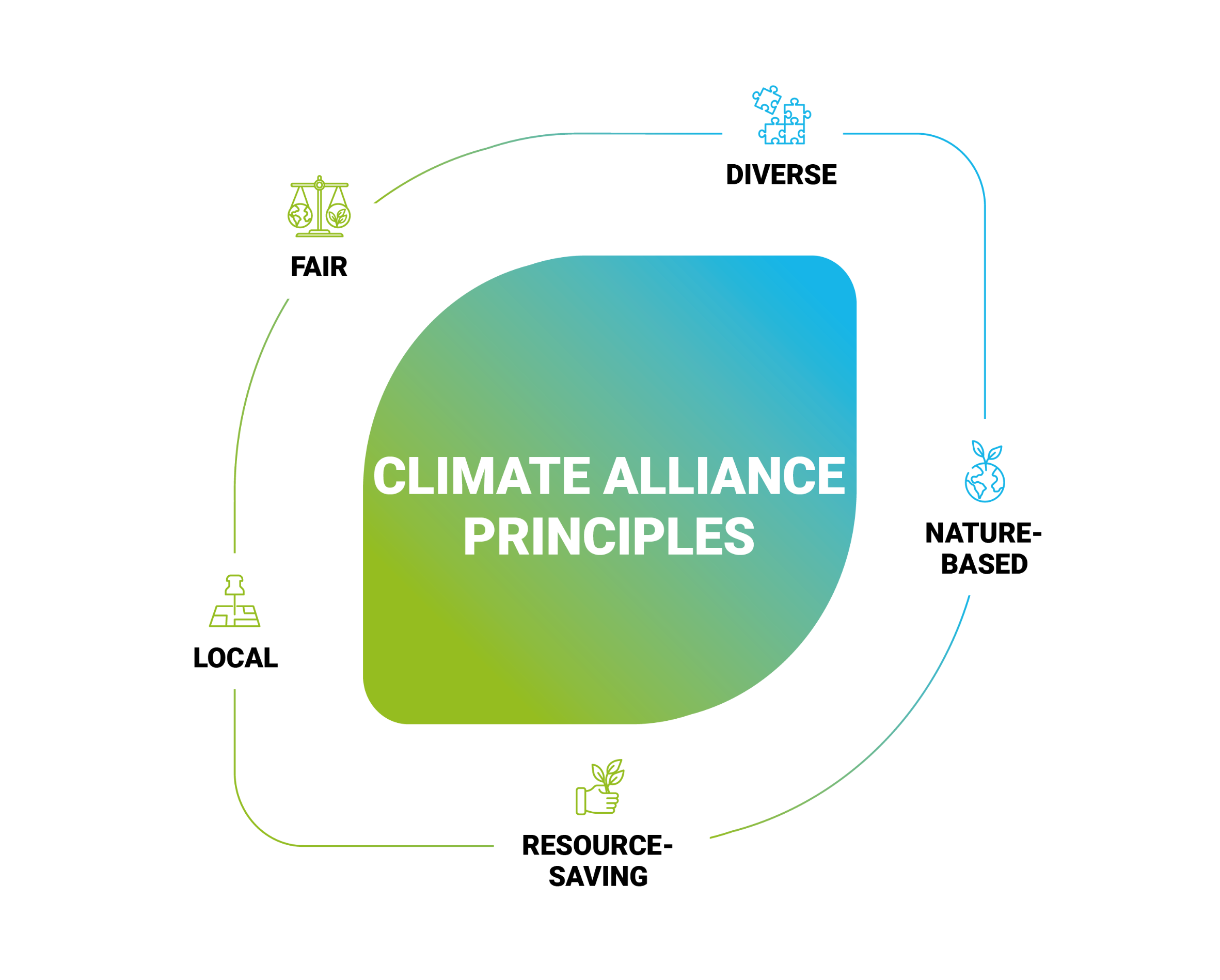
Fair, nature-based, local, resource-saving and diverse – these are the principles that underpin Climate Alliance’s work.
Climate action means much more than mere emissions reductions – how we achieve these reductions is at least as important. Climate Alliance members thus make a conscious commitment to both keep these values in mind in their efforts and to live up to them.
This is how climate protection and adaptation should look!
Climate Alliance principles
1

FAIR
Climate action must be just, promoting the well-being of all the world’s peoples – regardless of their culture, faith, gender, location or socio-economic status – in harmony with the natural evironment.
2
NATURE-BASED
Climate action cannot be based on overexploitation. Our actions must instead replenish and regenerate, contributing to sustainable, closed-loop systems in line with the needs of both society and nature.
3
LOCAL
A municipality’s sphere of influence is local by nature. Cities and towns can strengthen their resilience to crises by carrying out adaptation measures in their territories as well as by purchasing regionally-sourced goods and energy.
4
RESOURCE-SAVING
Even when it comes to climate action, we have to make careful use of our resources. That is why we place a focus on resource efficiency, resource saving and sufficiency – achieving more with less and ideally using less right from the start.
5
DIVERSE
Strength lies in diversity. Every town, city and district is unique. Making the most of the differences means that individual climate measures and their implementation differ from place to place. There is no one-size-fits-all answer.